
Nutrient Experiment
A Little Fertilizer Experiment
We've talked about what plant nutrients do, how inorganic fertilizers supply them, and how organic fertilizers build and feed the soil. But what happens when you actually give growing plants very different amounts of N, P and K?
I decided to find out. Using radish seedlings grown in silica sand, I compared three very different N-P-K fertilizers with a water-only control. And the differences weren't subtle.
Remember:
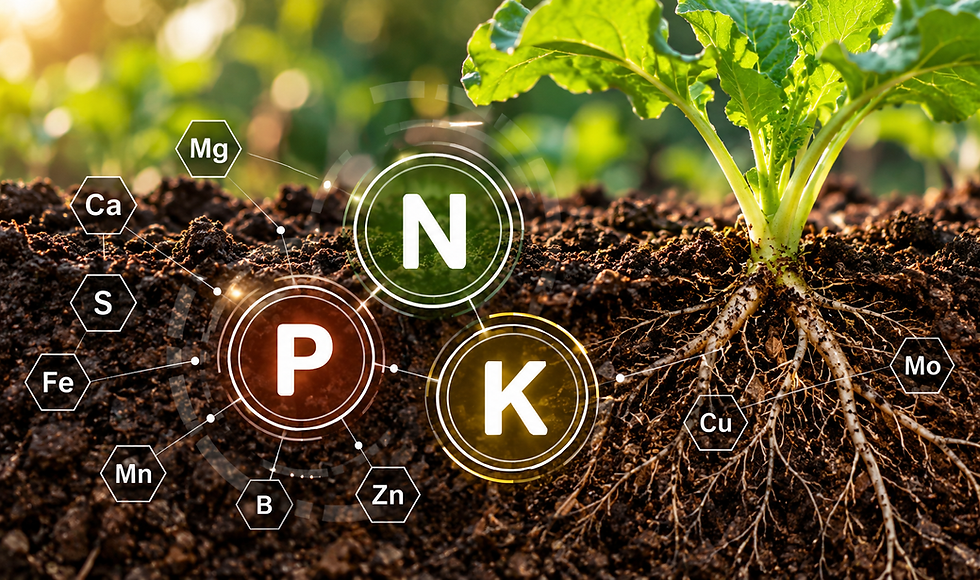
Nitrogen encourages green leafy growth
Phosphorous encourages the development of roots and flowers
Potassium increases water retention and encourages overall plant health.
Radish seeds were chosen since they germinate quickly. And, to eliminate the influence of nutrients in the soil itself, the seedlings were grown in common play sand.
Three different water soluble fertilizers were used with the following NPK concentrations:
A. 10 – 52 – 10 Very high Phosphorous
B. 12 – 0 – 44 Very high Potassium
C. 30 – 10 – 10 High Nitrogen
Four seeds were planted in each container. Three containers for each fertilizer and the control group were used. Seeds were all planted at the same depth. Containers were covered with plastic wrap and placed on a seed mat to germinate. Once they germinated they were moved to a table with a grow light. They were not fertilized until the first true leaves appeared. Seedlings were watered every three days, and the fertilizer groups were given fertilizer every week for 4 weeks. The results are shown below.

Results:
30-10-10 Seedlings developed large leaves but produced fewer leaves overall. Small root systems. The high nitrogen supply encouraged vigorous shoot and leaf growth, while root development was comparatively limited. Two seedlings also died, suggesting that the high fertilizer concentration may have caused additional stress.
10-52-10 Seedlings in this treatment produced the best overall growth, with healthy foliage and the most extensive root development. The higher phosphorus level likely contributed to strong early root development, resulting in a better-balanced seedling than the high-nitrogen treatment.
12-0-44 Seedlings in this group produced the greatest number of leaves, but individual leaves were smaller. The lower nitrogen level limited excessive leaf expansion, while the plants continued to initiate new leaves, resulting in compact, uniform growth with many smaller leaves. 12-0-44 is generally used as finishing fertilizer for perennials, ensuring strong healthy plants to endure winter months.
Water-only seedlings showed the poorest overall growth. Plants were small and weak, with limited leaf and root development. Because they were grown in silica sand, which supplied essentially no nutrients, the seedlings had to rely largely on nutrients stored in the seed and cotyledons. Once those reserves became insufficient, growth was severely limited. This contrasts clearly with the fertilized treatments and demonstrates that water alone cannot sustain normal seedling development over time.
Summary
Changing the balance of nitrogen, phosphorus and potassium produced visibly different plants. High nitrogen produced large leaves but relatively little root growth. High phosphorus produced the strongest roots and the best overall growth. The high-potassium fertilizer produced compact, uniform plants with lots of smaller leaves, while seedlings given only water struggled to grow at all.
The takeaway? More fertilizer—or a bigger N-P-K number—isn't necessarily better. What matters is supplying the nutrients a plant needs, in the right balance, at the right stage of growth.


Comments