
Nutrients 102
Inorganic Fertilizers
In a previous blog post we learned that all plants need 17 nutrients in order to grow. These are divided into Macronutrients and Micronutrients. While plants need all 17 to grow, macronutrients are needed in larger quantities.
Nutrient deficiency leads to a variety of problems, causing death in some cases and greatly reduced plant yield in others. However, determining deficiencies can be difficult, as many deficiencies are caused or influenced by environmental factors. For example, overwatering causes lack of oxygen and gas exchange which can result in the inability to uptake nutrients. Overwatering can also influence pH, which affects nutrient uptake. Once it has been determined that nutrient deficiency is at the root of the problem, plants can recover and thrive by balanced nutrient enhancement.
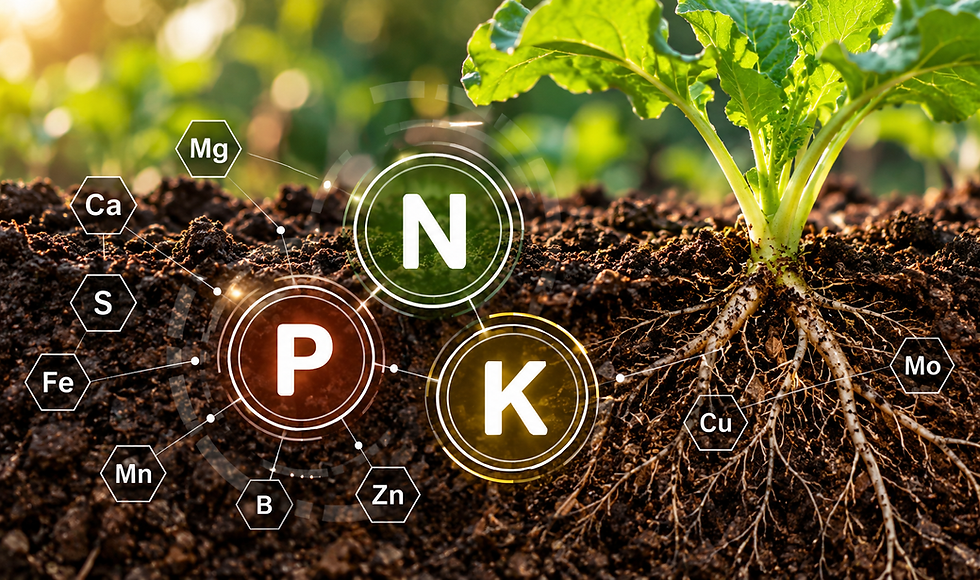
In most cases, the adjustment of the macronutrients, Nitrogen (N), Phosphorus (P) and Potassium (K) are all that is needed to correct the problem of nutrient deficiency, and many commercially available inorganic fertilizers focus on these 3 macronutrients in various combinations, listing them as concentrations of N-P-K.
And what do these three nutrients do?
UP N - Green leaf and stem growth
DOWN P - Roots and Flowers
ALL AROUND K - Overall plant health and disease resistance.
The higher the number, the more concentrated the nutrient is in the fertilizer. For example,
20-5-5 has four times more nitrogen than phosphorus and potassium. 20-20-20 fertilizer has twice as much concentration of all three nutrients than 10-10-10. These values also let you calculate the rate of fertilizer needed per volume of soil.
Unless you have a soil test kit, most people don't, you can rely on some standard guidelines. Plants EXTRACT nutrients, much the same way we EXTRACT fibre, protein, starches from food. So as a plant is growing it is using nutrients so the soil needs topping up each year.
Here's an easy example to follow:

Joe has 2 raised beds, that are 4' X 8'. It doesn't matter how deep they are because you mix fertilizer in the first 4" of soil.
Step 1: Joe finds the area of soil. 4 ft × 8 ft = 32 sq ft per bed. He has 2 beds, so 64 sq ft
Step 2: How much nitrogen? Joe hasn't done a soil test! But he knows he is growing lettuce and cabbage and they need a good supply of Nitrogen to grow. He just uses the general rate for vegetable gardens: 3.5 ounces of nitrogen per 100 sq ft.
That's about 2.2 lb per 1,000 sq ft. This is the number to remember
Step 3: Joe looks at the bag of fertilizer. The numbers are 10-10-10. That means 10% (0.10) of the bag is Nitrogen. The other two 10s are phosphorus and potassium and the rest is filler.
Joe calculates (2.2 lbs ÷ .10 ) × (64 sq ft ÷ 1,000) and gets 1.4 lb
Step 4: Joe needs to spread 1.4 lb across both beds, or 0.7 lb per bed.
Step 5: Joe doesn't have a scale. No Problem Joe! One cup weighs about 1/2 pound. so you need to spread 1 and 1/3 cups per bed.
Inorganic fertilizers are fast, cheap and easy to measure. What they don't do is feed the soil itself; they feed the plant and move on.
Next up, Nutrients 103: the organic route, where compost, manure and friends build better soil year after year.


Comments